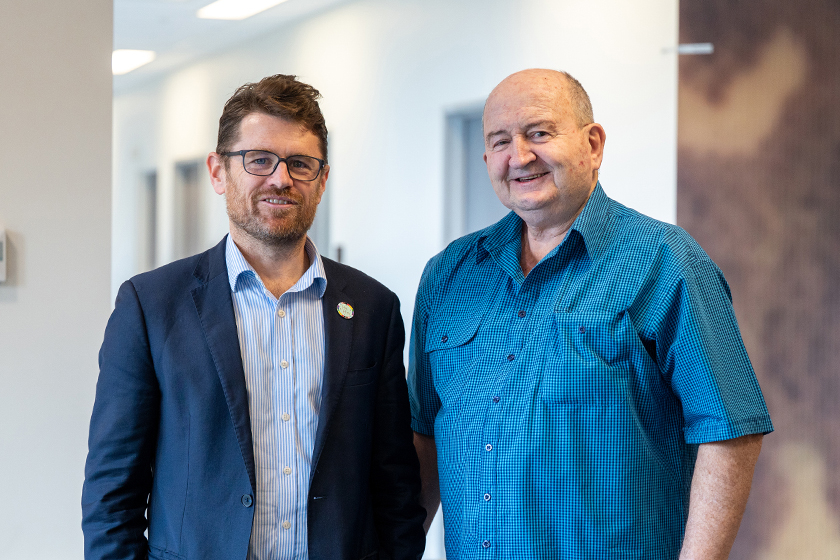
 Oncologist Dr Sam Harris (pictured at left) and Peter Lane
Clinical trials are often seen as research projects. For many patients, they can also be a pathway to new treatments and opportunities that may not otherwise be available.
Bendigo Health Medical Oncologist and Principal Investigator, Dr Sam Harris, says clinical trials are the foundation of modern healthcare, with every treatment decision informed by evidence gathered through past trials.
“When I see a patient, and I decide whether I want to give them chemotherapy or immunotherapy or surgery or whatever, I’m using information that hundreds, if not thousands of people before have been on a clinical trial to decide, does that treatment work?”
For regional communities, having access to trials locally can make a significant difference.
“It’s great to participate in a clinical trial. It’s not so great to drive two hours down to Peter MacCallum, or to The Alfred or the Austin, and two hours back,” Sam said.
“Being able to run those trials in Bendigo is important. It gives patients access to tomorrow’s treatment today.”
The impact of having clinical trials available locally can be life-changing. For Bendigo resident Peter Lane, access to a trial through Bendigo Health provided an opportunity that ultimately changed the course of his treatment.
Peter's cancer journey has been anything but straightforward.
“I’ve had three separate and variable cancers in the last five years. All of which were stage four, and all of which were treated here at this incredible facility (Bendigo Health),” Peter said.
After successfully undergoing major surgery and immunotherapy for two separate cancers, Peter was diagnosed with a third cancer last year. Around the same time, a study investigating a new treatment became available through Bendigo Health.
Peter enrolled and quickly noticed a difference.
“I had the first therapy on a Tuesday... three days after that, on the Friday... that pulse disappeared,” he said, describing tumours that had grown large enough for him to feel a pulse beneath his arm.
Follow-up scans showed the tumours continued to shrink and by November, he was declared cancer-free.
According to Sam, Peter’s outcome highlights why access to clinical trials matters.
“If we hadn’t been able to put Peter on that trial, we didn’t have another therapy that we could have offered,” Sam said. “This trial gave Peter a chance, and in Peter’s case, it worked amazingly.”
Peter’s experience is one example of how clinical trials can create opportunities when conventional treatment options have been exhausted.
While cancer research is often the most visible, clinical trials extend across many areas of healthcare. These carefully designed research studies help healthcare teams discover better ways to prevent, diagnose and treat illness. While some investigate new medicines or devices, others focus on exercise and rehabilitation programs, nutrition, surgery and new models of care.
At Bendigo Health, clinical trials are underway in areas including allied health, anaesthetics, cardiology, endocrinology, intensive care, infectious diseases, neurology, renal, respiratory, urology, women’s and children’s services and surgery.
Looking back on his experience, Peter is clear about the value of clinical trials.
“Here for the grace of a new drug, go I,” he said. “I cannot emphasise the importance of supporting these trials.”
Peter also credits optimism with helping him through some of life’s toughest challenges.
“I wish everyone who is currently in battle with cancer the very best. And please stay as positive as you possibly can, because it worked a treat for me, and always has.”
Peter's story is a reminder of why clinical trials matter. Whether they involve a new medication, an exercise program or a different approach to care, these studies provide patients with access to emerging treatments while helping shape the future of healthcare for generations to come.